
Turning Ocean Chemistry into Climate Action: Inside Captura's Approach to Marine Carbon Dioxide Removal
When Sophie Chu studied chemical engineering as an undergraduate, she wasn’t focused on ocean chemistry, much less marine carbon dioxide removal.
“I had always loved the ocean,” she says, recalling a childhood in Connecticut spending long hours exploring the coast with her family. “But for some reason I never thought about it as a career.”
That changed after graduating college in 2009, when she read an article about the North Pacific Garbage Patch—a vast concentration of marine debris—and her attention was drawn to marine threats.
She applied to PhD programs in oceanography and began focusing on carbon cycling, ocean acidification, and the tools needed to measure carbon in seawater.
Today, Chu is principal oceanographer at Captura, a California-based company developing a type of marine carbon dioxide removal (mCDR) to boost the ocean’s natural ability to capture and store carbon dioxide (CO₂) from the atmosphere.
The ocean’s hidden role, and its limits
For more than two centuries, the ocean has buffered the impacts of climate change, absorbing roughly a quarter of the CO₂ produced by human activity.
But that service comes at a cost. Ocean chemistry has shifted, making seawater about 30 percent more acidic on average. At the same time, atmospheric CO₂ levels continue to climb, intensifying storms, heatwaves, and droughts. Even with rapid emissions reductions, scientists scientists agree that removing carbon already in the atmosphere will be essential.
That’s where the growing field of mCDR comes in, and where Captura and Ocean Visions are working to make a difference.
Rethinking how carbon can be removed
Captura’s technology traces back to a breakthrough at the California Institute of Technology. In 2021, researchers CX Xiang and Harry Atwater revisited electrodialysis, an electrochemical process traditionally used to separate salts from water. The idea of using electrodialysis for carbon removal wasn’t new, but it had long been considered too expensive to scale. Xiang and Atwater changed that by developing new membranes—special filters that let only certain charged particles pass—and significantly improving the system’s efficiency.
Their work laid the foundation for the approach taken by Captura, which Xiang and Atwater co-founded and where they now serve as Chief Technology Officer and Chief Science Officer, respectively.
The company’s system splits seawater into two streams: one acidic, one alkaline. The acidic stream is added to a flow of seawater inside the plant to convert dissolved inorganic carbon into dissolved CO₂, which can then be captured. The alkaline stream is then added to the decarbonized water, now with slightly higher pH than ambient seawater, and that is returned to the ocean, where it can absorb additional carbon dioxide from the air.
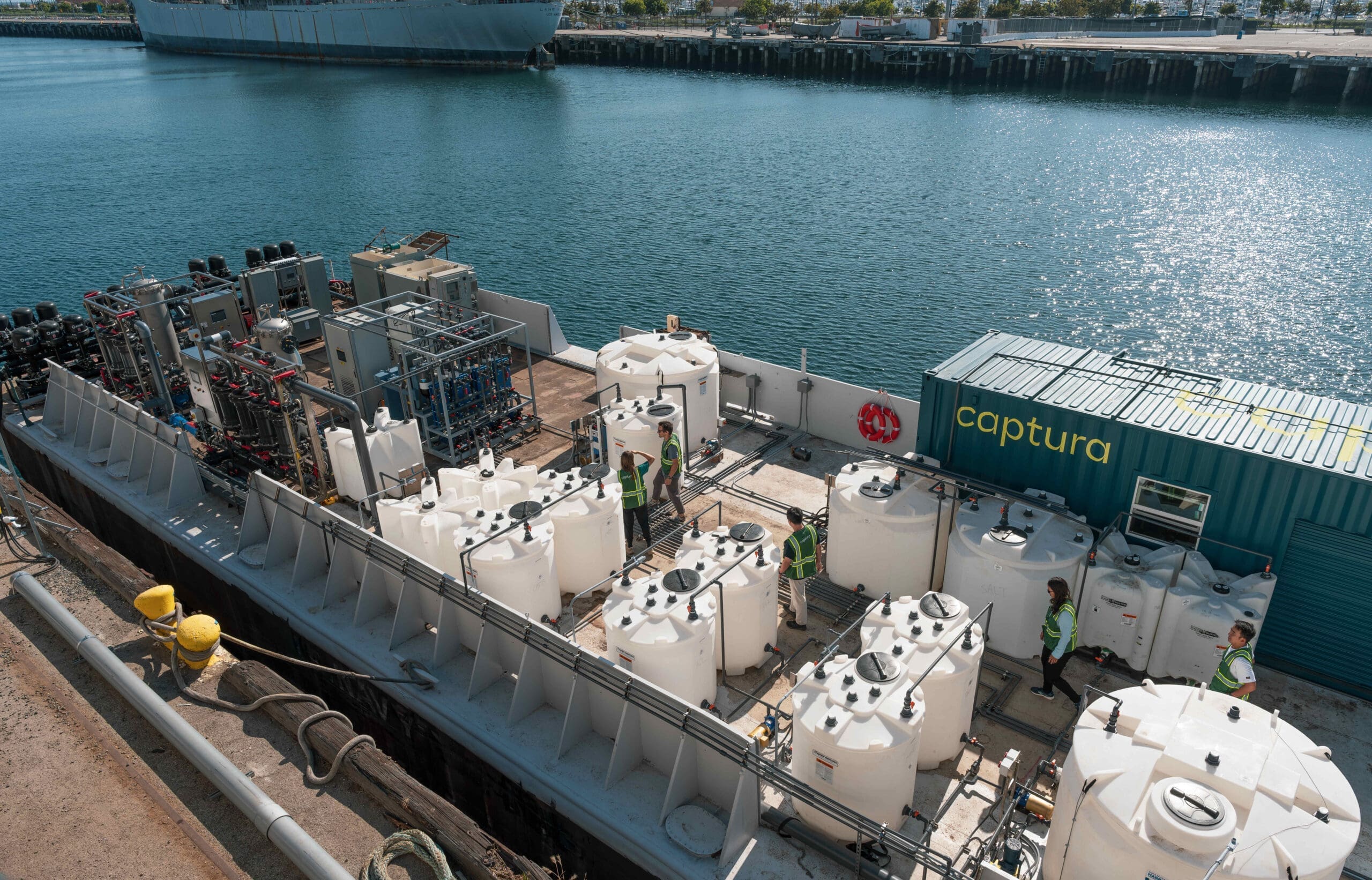
Captura’s largest pilot facility, located in Hawai‘i, is already removing about 1,000 tons of CO₂ per year. While a small step, it demonstrates that the technology can work reliably outside the lab. The captured CO₂ can be stored permanently to deliver carbon removal or utilized to produce low carbon products such as fuel.
For Chu, the promise of the system lies not just in its effectiveness, but also its design. “It’s designed for scale,” she says.
“We don’t have external inputs, we don’t have byproducts. And there’s flexibility in how you deploy it. Plants can be co-located with coastal infrastructure or built offshore on retired oil and gas platforms, while the technology’s flexible energy demand enables the use of off-peak or curtailed power for much of its energy needs.”
“We (newcomers to commercial enterprises) are not always familiar with how existing ocean industries operate. Launchpad helped us see how much we can learn from businesses that already do this.”
Dr. Sophie Chu, Principal Oceanographer and Director of MRV, Captura

From research to real-world impact
Chu’s journey to Captura included years in academia and government research, with roles at the University of Washington and NOAA’s Pacific Marine Environmental Laboratory. But she found herself drawn to something different: the chance to apply her expertise more directly.
“In academia, projects operate on longer timelines,” she says. “Here, in a startup company in a new field, everything moves faster. We’re building something completely new and helping write the rules at the same time so we can move with both urgency and intention.”
That speed brings both excitement and responsibility, especially in her role overseeing measurement, reporting, and verification (MRV)—a cornerstone of credible carbon removal.
For Chu, this part of her job focuses on two essential dimensions. The first is quantitative: proving that carbon removal is happening and measuring it accurately. The second relates to environmental impacts: understanding how systems that process seawater might affect marine life.
On the environmental side, facilities must make sure marine organisms are not harmed through the intake and discharge of seawater. These are well-studied issues in industries like desalination.
“We’re not starting from scratch,” Chu says. “There are other ocean industries that already have protocols. We can learn from them.”
The role of Ocean Visions
Captura’s progress has been supported in part by Ocean Visions’ Launchpad program, which helps innovators navigate scientific, environmental, and regulatory challenges. For Chu, Launchpad offered a way to step back and think strategically—something that can be hard to do in a fast-moving startup.
Working with advisors in oceanography, biology, and regulatory policy, the team identified key questions early: What will regulators need to know? What environmental risks require more study? Where should limited research resources be focused?
“It was about being proactive,” Chu says. “What are people going to ask us, and how do we have good answers ready?”
The program also helped bridge a gap between scientific research and real-world deployment.
“A lot of people in this field come from academia or government,” she says. “We (newcomers to commercial enterprises) are not always familiar with how existing ocean industries operate. Launchpad helped us see how much we can learn from businesses that already do this.”
Equally valuable was the space for open dialogue.
“We had this forum where we could talk openly about uncertainties and challenges,” she says. “That kind of exchange is really important when you’re building something that hasn’t been done before.”
Looking ahead
Captura’s current systems represent an early step in building a new class of tools—ones that could help remove carbon at meaningful levels while minimizing harm to ocean ecosystems.
As the company works toward larger deployments, Chu remains focused on ensuring that growth is grounded in sound science and transparency.
For her, the path from a curious kid exploring the Connecticut shoreline to a scientist helping shape the future of potential ocean-based climate solutions still feels a bit unexpected.
But in hindsight, it fits.
“All the pieces were there,” she says. “I just hadn’t put them together yet.”