
Ocean Sciences Meeting 2026
From February 22-27, experts will convene in Glasgow, Scotland for the 2026 Ocean Sciences Meeting to advance dialogue and ignite action to combat our planet’s most pressing ocean challenges, including climate disruption—the top threat to our oceans. Ocean Visions will be making meaningful contributions through a series of events, workshops, and sideline discussions, focused on our four-part strategic agenda to directly address the causes and impacts of climate disruption.
Explore the schedule below to learn more about where we’ll be and how you can connect with us on the ground!
February 23, 2026
16:00 - 18:00; Hall 4 (Poster Hall) (SEC)
Phytoplankton-based marine carbon dioxide removal (mCDR) represents a range of diverse, potentially scalable approaches to drawing down atmospheric CO₂. These pathways enhance ocean primary productivity and/or organic carbon export to the deep ocean and could potentially complement ocean alkalinity enhancement in realizing the full potential of mCDR as part of a larger CDR portfolio.
In this session, Ocean Visions will present the program design: its goals, structure, and early activities, highlighting opportunities for partnership and collaborative knowledge generation.
February 24, 2026
12:45-13:45; Lomond Auditorium (SEC)
This Town Hall brings together science, policy, and community-based organizations to discuss the current landscape and future directions of research, development, and Monitoring, Reporting, and Verification (MRV) of mCDR technologies.
February 24, 2026
16:00-18:00 Hall 4 (Poster Hall) (SEC)
Africa has great potential for advancing mCDR. However, gaps in coordinated efforts to guide research, innovation, and policy remain, hindering the advancement, development, and deployment of mCDR technologies in the region. In response, a continent-wide roadmap has been initiated to guide research, development, and demonstration (RD&D) of mCDR approaches tailored to Africa’s unique ecological, social, and economic contexts.
This session seeks to attract interdisciplinary contributions for mCDR RD&D from Africa and beyond, and to include current research activities, community engagement, innovation and inclusive governance.
February 25, 2026
12:45-13:45; Forth (SEC)
The use of marine processes and environments to actively remove and/or store atmospheric CO2 may play a significant role in achieving the extent of carbon dioxide removal (CDR) needed to help tackle climate change. However, such interventions may also pose risks to marine ecosystems and the communities dependent on them. Establishing an ethically and ecologically robust Environmental Impact Assessment Framework (EIAF) is therefore essential for guiding both initial research-driven evaluations and potential future commercial implementations of mCDR techniques.
This town hall seeks to facilitate cross-disciplinary discussions and input on EIAF requirements by uniting researchers, practitioners and decision makers interested in mCDR approaches and their implications
February 25, 2026
16:00-18:00 Hall 4 (Poster Hall) (SEC)
The ocean is central to climate resilience, biodiversity, and sustainable economies. Accelerating human impacts demand bold, systems-level solutions that necessitate a departure from traditional paradigms, embracing holistic, transdisciplinary approaches integrating science, technology, policy, and workforce development.
Join Ocean Visions to explore case studies, innovations, and capacity-building efforts from around the world. This session aims to connect scientists, educators, entrepreneurs, and policymakers in an open exchange that advances the UN Ocean Decade’s goals and drives inclusive, forward-looking ocean solutions.
February 26, 2026
10:30-12:00; Hall 3, Blue Horizon (SEC)
The ocean is central to climate resilience, biodiversity, and sustainable economies. Accelerating human impacts demand bold, systems-level solutions that necessitate a departure from traditional paradigms, embracing holistic, transdisciplinary approaches integrating science, technology, policy, and workforce development.
Following our poster session, join us in person to explore case studies, innovations, and capacity-building efforts from around the world. This session aims to connect scientists, educators, entrepreneurs, and policymakers in an open exchange that advances the UN Ocean Decade’s goals and drives inclusive, forward-looking ocean solutions.
February 26, 2026
14:00-14:40 Dochart (SEC)
Reducing emissions of greenhouse gases and removing CO2 from the atmosphere, while required for climate stabilization, are unlikely to cool the planet in time to avoid devastating impacts from climate change. Arctic sea ice, which facilitates global climate stability through its high albedo, is a system at high risk.
This session will provide an overview of the road map and highlight researchers working on a subset of approaches, including modeling studies, field research, and studies of ecological impacts.
February 26, 2026
14:50-15:30; Dochart (SEC)
The Global Ecosystem for Ocean Solutions (GEOS), a program of Ocean Visions and endorsed by the UN Decade of Ocean Science for Sustainable Development, is a global network accelerating the development and scaling of equitable, science-based ocean-climate solutions. GEOS brings together leading scientists, innovators, policy actors, funders, and community organizations to collaboratively design, test, and advance strategies that address the interlocked crises of ocean degradation and climate change.
This session will share concrete examples of solution-oriented collaborations advanced through GEOS, including pilots in marine carbon dioxide removal (mCDR), ecosystem restoration, exploration of wicked climate and biodiversity issues, and science-policy nexus regional assessments.
February 27, 2026
8:48 - 8:51 Hall 4 eLightning Theater 1 (SEC)
Seaweeds are a promising low-carbon feedstock for a range of products, including bioplastics, fuels, and agricultural supplements. Their responsible cultivation and use can mitigate land use conflicts. However, many of these seaweed-based products haven’t been able to make an impact at scale due to scientific and technological uncertainties, regulatory complexity, and market barriers.
To address these roadblocks, we developed the Low-Carbon Seaweed Product Roadmap—an open collaborative tool that outlines the critical pathways for scaling products from research through to market.
Join us for an elightning talk that brings together diverse actors to address challenges and seize innovation opportunities in seaweed aquaculture.
Meet our Delegation
Meet the OV team attending this year’s Ocean Sciences Meeting! We invite you to reach out to connect with them over the course of the week.
In addition to our featured sessions, you can find team members at booth #102 on the exhibition floor throughout the week. Be sure to stop by to say hello and learn more about Ocean Visions’ work.
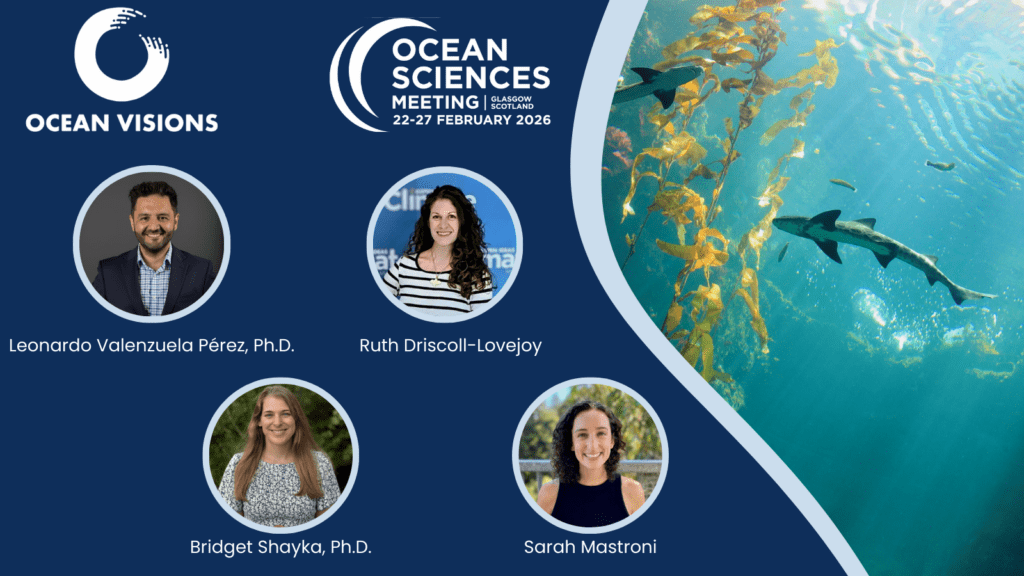
- Leonardo Valenzuela Pérez, Ph.D., Senior Director, International Partnerships & Policy
- Ruth Driscoll-Lovejoy, Program Director, Remove
- Bridget Shayka, Ph.D., Program Officer, Repair
- Sarah Mastroni, Senior Program Officer
.