
Ocean Sciences Meeting 2026

Ocean Sciences Meeting 2026

From February 22-27, experts will convene in Glasgow, Scotland for the 2026 Ocean Sciences Meeting to advance dialogue and ignite action to combat our planet’s most pressing ocean challenges, including climate disruption—the top threat to our oceans. Ocean Visions will be making meaningful contributions through a series of events, workshops, and sideline discussions, focused on our four-part strategic agenda to directly address the causes and impacts of climate disruption.

Explore the schedule below to learn more about where we’ll be and how you can connect with us on the ground!
February 23, 2026

16:00 - 18:00; Hall 4 (Poster Hall) (SEC)

Phytoplankton-based marine carbon dioxide removal (mCDR) represents a range of diverse, potentially scalable approaches to drawing down atmospheric CO₂. These pathways enhance ocean primary productivity and/or organic carbon export to the deep ocean and could potentially complement ocean alkalinity enhancement in realizing the full potential of mCDR as part of a larger CDR portfolio.


In this session, Ocean Visions will present the program design: its goals, structure, and early activities, highlighting opportunities for partnership and collaborative knowledge generation.

February 24, 2026

12:45-13:45; Lomond Auditorium (SEC)

This Town Hall brings together science, policy, and community-based organizations to discuss the current landscape and future directions of research, development, and Monitoring, Reporting, and Verification (MRV) of mCDR technologies.

February 24, 2026

16:00-18:00 Hall 4 (Poster Hall) (SEC)

Africa has great potential for advancing mCDR. However, gaps in coordinated efforts to guide research, innovation, and policy remain, hindering the advancement, development, and deployment of mCDR technologies in the region. In response, a continent-wide roadmap has been initiated to guide research, development, and demonstration (RD&D) of mCDR approaches tailored to Africa’s unique ecological, social, and economic contexts.

This session seeks to attract interdisciplinary contributions for mCDR RD&D from Africa and beyond, and to include current research activities, community engagement, innovation and inclusive governance.

February 25, 2026

12:45-13:45; Forth (SEC)

The use of marine processes and environments to actively remove and/or store atmospheric CO2 may play a significant role in achieving the extent of carbon dioxide removal (CDR) needed to help tackle climate change. However, such interventions may also pose risks to marine ecosystems and the communities dependent on them. Establishing an ethically and ecologically robust Environmental Impact Assessment Framework (EIAF) is therefore essential for guiding both initial research-driven evaluations and potential future commercial implementations of mCDR techniques. 

This town hall seeks to facilitate cross-disciplinary discussions and input on EIAF requirements by uniting researchers, practitioners and decision makers interested in mCDR approaches and their implications

February 25, 2026

16:00-18:00 Hall 4 (Poster Hall) (SEC)

The ocean is central to climate resilience, biodiversity, and sustainable economies. Accelerating human impacts demand bold, systems-level solutions that necessitate a departure from traditional paradigms, embracing holistic, transdisciplinary approaches integrating science, technology, policy, and workforce development.

Join Ocean Visions to explore case studies, innovations, and capacity-building efforts from around the world. This session aims to connect scientists, educators, entrepreneurs, and policymakers in an open exchange that advances the UN Ocean Decade’s goals and drives inclusive, forward-looking ocean solutions.

February 26, 2026

10:30-12:00; Hall 3, Blue Horizon (SEC)

The ocean is central to climate resilience, biodiversity, and sustainable economies. Accelerating human impacts demand bold, systems-level solutions that necessitate a departure from traditional paradigms, embracing holistic, transdisciplinary approaches integrating science, technology, policy, and workforce development.

Following our poster session, join us in person to explore case studies, innovations, and capacity-building efforts from around the world. This session aims to connect scientists, educators, entrepreneurs, and policymakers in an open exchange that advances the UN Ocean Decade’s goals and drives inclusive, forward-looking ocean solutions.

February 26, 2026

14:00-14:40 Dochart (SEC)

Reducing emissions of greenhouse gases and removing CO2 from the atmosphere, while required for climate stabilization, are unlikely to cool the planet in time to avoid devastating impacts from climate change. Arctic sea ice, which facilitates global climate stability through its high albedo, is a system at high risk.

This session will provide an overview of the road map and highlight researchers working on a subset of approaches, including modeling studies, field research, and studies of ecological impacts.

February 26, 2026

14:50-15:30; Dochart (SEC)

The Global Ecosystem for Ocean Solutions (GEOS), a program of Ocean Visions and endorsed by the UN Decade of Ocean Science for Sustainable Development, is a global network accelerating the development and scaling of equitable, science-based ocean-climate solutions. GEOS brings together leading scientists, innovators, policy actors, funders, and community organizations to collaboratively design, test, and advance strategies that address the interlocked crises of ocean degradation and climate change. 

This session will share concrete examples of solution-oriented collaborations advanced through GEOS, including pilots in marine carbon dioxide removal (mCDR), ecosystem restoration, exploration of wicked climate and biodiversity issues, and science-policy nexus regional assessments.

February 27, 2026

8:48 - 8:51 Hall 4 eLightning Theater 1 (SEC)

Seaweeds are a promising low-carbon feedstock for a range of products, including bioplastics, fuels, and agricultural supplements. Their responsible cultivation and use can mitigate land use conflicts. However, many of these seaweed-based products haven’t been able to make an impact at scale due to scientific and technological uncertainties, regulatory complexity, and market barriers.  

To address these roadblocks, we developed the Low-Carbon Seaweed Product Roadmap—an open collaborative tool that outlines the critical pathways for scaling products from research through to market.  

Join us for an elightning talk that brings together diverse actors to address challenges and seize innovation opportunities in seaweed aquaculture.  

Meet our Delegation

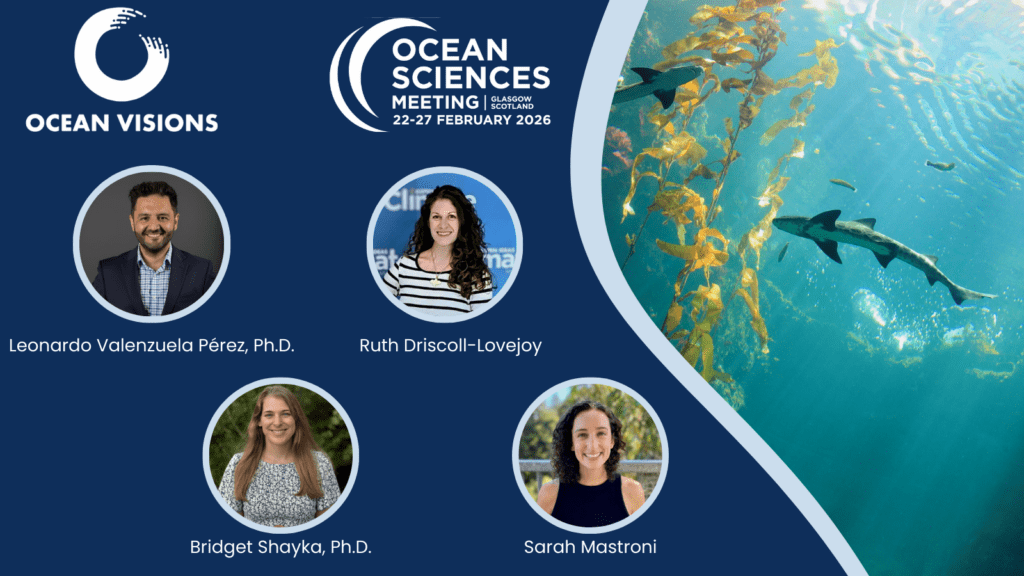
Meet the OV team attending this year’s Ocean Sciences Meeting! We invite you to reach out to connect with them over the course of the week.  

In addition to our featured sessions, you can find team members at booth #102 on the exhibition floor throughout the week. Be sure to stop by to say hello and learn more about Ocean Visions’ work.  
 

Ocean Visions at AGU24

Ocean Visions at AGU24

Join Ocean Visions at AGU24, December 9-13, 2024, in Washington, D.C.

Each year AGU’s annual meeting, the largest gathering of Earth and space scientists, convenes 25,000+ attendees from 100+ countries. Ocean Visions will be at AGU24 to expand the dialogue and advance action around solutions at the ocean-climate nexus. We are leading and participating in several events, and invite attendees to join us at those that are open to all registrants.

Events

Ocean Visions’ Arctic Sea Ice Road Map: An assessment of proposed approaches to slow the loss of Arctic sea ice

Date: Monday, 9 December 2024
Time: 08:30 – 12:30
Location: Hall B-C (Poster Hall) (Convention Center)

Reducing emissions of greenhouse gases and removing CO2 from the atmosphere, while urgent and non-negotiable for climate stabilization, is unlikely to cool the planet in time to avoid continued devastating impacts from climate change. Arctic sea ice, which serves an important role in global climate stability through its high albedo, is a system at high risk. The loss of summer sea ice estimated to occur in the coming decades will worsen impacts to ecosystems, Arctic people, and global climate. Ocean Visions led a collaborative research and analytical process to assess the current status and priorities to advance understanding of potential actions to slow the loss of Arctic sea ice guided by an international advisory board and discussions with >100 individuals. This talk will share highlights from the findings of the road map. 

mCDR Community Gathering

Date: Tuesday, 10 December 2024
Time: 18:30 – 21:30
Location: ARTECHHOUSE DC, 1238 Maryland Ave SW, Washington, D.C. 20024

Join Ocean Visions and co-hosts ExOIS, Carbon to Sea Initiative, [C]Worthy, and Ocean Carbon & Biogeochemistry for an evening at ARTECHOUSE DC.
 

This is a great chance to connect with fellow members of the marine carbon dioxide removal community in an inspiring setting, where we can share ideas, network, and enjoy a night of small bites, drinks, and immersive art.


We ask that you 
please RSVP  so we can plan accordingly. 

3 COPs of 2024: Outcomes and Reflections

Date: Wednesday, 11 December 2024
Time: 16:00 – 17:30
Location: Treasury (Marriott Marquis)

In 2024, three historic United Nations science meetings were held – the sixteenth session of the Conference of the Parties on Biological Diversity, the twenty-ninth session of the Conference of Parties on Climate Change, and the sixteenth session of the Conference of the Parties to Combat Desertification.


Join Ocean Visions in this session to learn about the progress and challenges in achieving international targets, the role of science and scientists in advancing global sustainability policies, and how AGU members are engaging in these pivotal events.

Navigating Uncertainty: Assessing and Communicating Risk in Marine Carbon Dioxide Removal Research, Development, and Deployment Poster

Date: Friday, 13 December 2024
Time: 08:30 – 12:20
Location: Hall B-C (Poster Hall) (Convention Center)

As society grapples with the urgent need to mitigate climate change, innovative solutions such as marine carbon dioxide removal (mCDR) hold promise alongside uncertainties and risks.


This session will explore social science contributions to the critical nexus of risk assessment and communication in stakeholder engagement for mCDR research and development (R&D). We seek insights on the systematic assessment and transparent communication of risks and benefits of mCDR R&D to local communities, policymakers, and industry leaders, as well as best practices for identifying, evaluating, and managing risks and co-benefits while fostering meaningful stakeholder participation.


This session seeks to share knowledge on mCDR as an effective, durable, transparent, and equitable climate solution.

CONNECT WITH THE OCEAN VISIONS DELEGATION

Numerous staff will be in attendance at AGU24. Please feel free to reach out to us via email before or during the event to arrange for a meetup.


Ocean Visions at the Ocean Sciences Meeting 2024

Ocean Visions at Ocean Sciences Meeting 2024

Ocean Visions will be at the Ocean Sciences Meeting 2024 (OSM) to expand the dialogue and advance action around solutions at the ocean-climate nexus. We will be leading a number of events, and invite attendees to join us at those that are open to all registrants:

  • Advancing Responsible Field Trials: A Workshop for Ocean Alkalinity Enhancement with Co-Hosts Carbon to Sea and [C]worthy

    Sunday, 18 February 2024 | 9:00 – 12:00 CST | 223, Second Floor (NOLACC)
    While ocean alkalinity enhancement (OAE) continues to be explored in lab and mesocosm settings, an increasing number of field trials are being deployed and planned in natural environments. These opportunities provide valuable insights into how alkalinity behaves in open systems, and how we might best measure its effects. This workshop will aim to bring together the researchers on the front lines of OAE to share their lessons learned with those in the planning stages, and includes important topics such as: trial scope and design, identifying and measuring ecological and social impacts, regulatory and permitting, community-engagement, MRV technologies and models, and high-impact resources and processes that worked for teams. Learn More & Register

  • mCDR Networking Event (SOLD OUT)

    Monday, 19 February 2024 | 6:30 – 9:30 CST | Audubon Aquarium
    Join Ocean Visions and co-hosts Ocean Carbon & Biogeochemistry, [C]Worthy, Carbon to Sea Initiative, and Exploring Ocean Iron Solutions for a marine carbon dioxide removal (mCDR) networking event. All are welcome, from those interested in learning more, to engaging in research, to exploring potential partnerships. We aim to convene a diverse group to share information and explore collaborations. Stop by for some or all of this three-hour event featuring introductory remarks from hosts and then mingling over food and beverage. 

  • CM31A-04 Ocean-based Carbon Dioxide Removal in the 2020s: Getting Answers to the Important Questions

    Wednesday, 21 February 2024 | 8:55 – 9:03 CST | R04-R05, Second Floor (NOLACC)
    Ocean-based carbon dioxide removal has made tremendous scientific, technical, and social progress in the last several years, yet much work remains to develop confident answers to the question of whether, and how, ocean-based CDR approaches are going to be a part of the toolkit needed to deliver gigaton-scale carbon dioxide removal by mid-century. In this talk, Ocean Visions will present its framework for doing this work, aiming to spark a larger discussion about how to deliver high-quality research and development to maximize knowledge and inform decision making. Learn More

  • TH43D – Establishing Ocean Carbon Dioxide Removal Policies

    Thursday, 22 February 2024 | 12:45 – 1:45 CST | Hall C-1, First Floor (NOLACC)
    The world’s nations have set goals of limiting global emissions of greenhouse gases in the hope of limiting the global average temperature increase to no more than 2 degrees Celsius above pre-industrial levels. The strong possibility that the world will overshoot this target has led many organizations, companies, and others to explore ways of intervening in the Earth’s climate. However, currently there is no solid governance framework, internationally and in the U.S., for ocean carbon dioxide removal (CDR). In the absence of a governance framework, numerous questions exist related to the social and environmental impacts of ocean CDR, research needs and funding, as well as permitting, monitoring, and verification. In this townhall, we’ll discuss current efforts to create policies to enable responsible and ethical ocean carbon dioxide removal, as well as challenges and opportunities in making policies a reality. Learn More & Register

  • TH43F – Fostering Partnerships by Building on the Framework of the Ocean Decade

    Thursday, 22 February 2024 | 12:45 – 1:45 CST | 217-219, Second Floor (NOLACC)
    The United Nations Decade of Ocean Science for Sustainable Development 2021-2030 (Ocean Decade) is a global cooperative program to expand scientific, social, and economic partnerships to support sustainable development and management of our coasts and ocean. This town hall will showcase successful partnership stories that were built through leveraging the unique opportunity for an unprecedented level of collaboration for innovation and transformational change that the Ocean Decade presents. The panel discussion will allow attendees to walk away with an understanding of the Ocean Decade and how it directly connects to their research, outreach, and partnerships, whether in their local community or on an international scale. We aim for the session to highlight how the goals and priorities of the Ocean Decade forge greater cooperation and collaboration and provide insight on how scientists can engage. Learn More & Register

  • HD52A-05 – Challenges of Ocean Science Education in Kenya and the Way Forward (NOTE: Talk given by Mariam Maku Swaleh Mwasaria, Coordinator of Kenya Ocean-Climate Innovation Hub in partnership with Ocean Visions’ Global Ecosystem for Ocean Solutions)

    Friday 23 February 2024 | 11:30 – 11:45 CST | 225-227, Second Floor (NOLACC)
    Climate change has disproportionately affected the poorest coastal communities in Kenya. In addition, other human activities, connected to poverty, have made the situation worse. People living near the ocean still cut down mangrove trees for different uses, resulting in damage to a critical ecosystem. Overfishing has resulted in a decline in fish populations, affecting livelihoods. Ocean-climate solutions must benefit communities that depend on the ocean, and an interdisciplinary approach should be adopted in marine science research and business applications. With support from Ocean Visions, and in partnership with leading local research institutions, an ocean-climate innovation hub is developing in Kenya to provide a platform for science graduates, researchers, and ocean-climate startups to support innovative ocean-based climate solutions. Learn More


CONNECT WITH THE OCEAN VISIONS DELEGATION

Numerous staff will be in attendance at OSM. Please feel free to reach out to us via email before or during the event to arrange for a meetup.


Additionally, we invite you to stop by booth #343, where we will have staff stationed as much as possible throughout the event. Hope to see you there!