Marine Carbon Dioxide Removal
Ocean & Climate: Inextricably Linked
Covering 70 percent of Earth’s surface, the ocean has helped to protect humanity and terrestrial life from the worst effects of climate disruption by both absorbing more than 25 percent of all anthropogenic carbon dioxide (CO2) pollution and more than 90 percent of the excess heat trapped in the biosphere.
Unfortunately, this is bleaching corals, melting sea ice, and acidifying the ocean at alarming rates—unraveling marine ecosystems and crippling the ability of the ocean to support the billions of people and other creatures dependent upon it.
Learn more about climate impacts on the ocean
Addressing the Ocean-Climate Crisis
Ongoing climate disruption poses such an existential threat to the ocean that traditional protection efforts unfortunately are no longer enough; we must slow and reverse climate change.
Rapid and deep reductions of greenhouse gas emissions remain paramount in addressing the ocean-climate crisis. While vital, this path alone is no longer sufficient. The Intergovernmental Panel on Climate Change has made clear that large-scale carbon dioxide removal (CDR) is also needed.
CDR can take many forms, from land management practices such as forest restoration, to technologies like direct air capture. To date, most CDR development has been focused on land, but the power of the ocean to sequester and safely store carbon dioxide is massive compared to that of its terrestrial counterparts:
- The ocean holds more carbon than any other part of Earth’s biosphere
- The ocean’s size would enable viable pathways to be scaled
Marine Carbon Dioxide Removal
Given the pace and scale of the climate disruption underway, and the very real danger of surpassing critical ecological tipping points, it is imperative to accelerate the research and testing of marine carbon dioxide removal (mCDR) pathways.
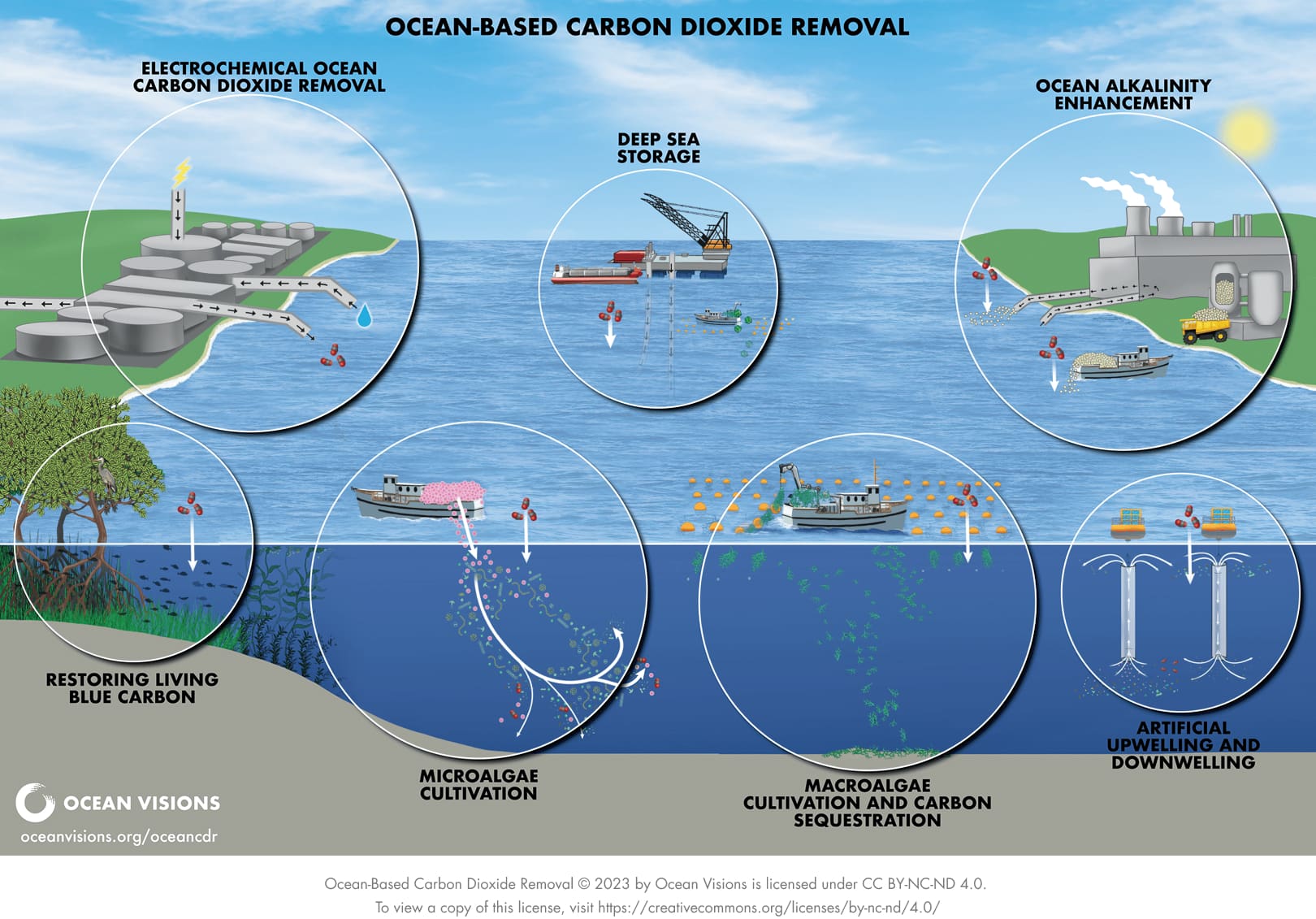
Many types of mCDR approaches are being explored. Read more and download illustrations for each pathway: