
The ocean and climate are inextricably linked. There can be no healthy ocean without stopping climate disruption, and the climate cannot recover without the ocean.
For billions of years, the ocean has helped regulate Earth’s climate. The ocean absorbs heat and cycles carbon, helping to regulate and maintain the climate conditions that have allowed life and humanity to evolve and flourish. But over the past 250 years, human activities have significantly altered that balance.
Burning fossil fuels and changes in land use, such as deforestation, have released large amounts of heat trapping gases, especially carbon dioxide (CO₂), methane (CH₄), and nitrous oxide (N₂O), into the atmosphere. These gases trap additional heat in Earth s system that previously escaped into space, creating an energy imbalance that has caused the planet to warm.
Additionally, as temperatures have risen, ice covered areas glaciers, ice sheets, and sea ice are melting and receding. These bright surfaces reflect sunlight back into space, and as ice melts and retreats, darker ocean and land surfaces absorb more heat, further increasing the planet’s energy imbalance and adding to the warming.

Ocean Warming and Acidification Are Driving Global Change
This planetary energy imbalance, together with the large amount of excess CO2 in the atmosphere, are driving the two biggest changes to the ocean: warming and acidification. These two drivers in turn are connected to multiple additional stressors that are already affecting marine life and coastal communities, and reshaping ocean systems.
Ocean Warming
Ocean warming is the most widespread and immediate stress. The ocean absorbs 93% of the extra heat trapped heat on the planet, a staggering quantity that in 2025 was equal to more than 200 times the total amount of electrical energy generated by humanity. This heat absorption has led to rising temperatures throughout both surface and deep waters, reshaping marine ecosystems in a number of ways:

- Deoxygenation
Warmer water holds less dissolved oxygen and creates changes in ocean stratification and circulation reducing the mixing that replenishes oxygen at depth. Observations show declining oxygen levels in many regions, shrinking habitable zones and stressing marine life. - Sea level rise
Rising sea levels are caused by thermal expansion of seawater and by melting of glaciers and ice sheets into the ocean. Since 1960, thermal expansion of seawater from ocean heat uptake has accounted for 43 percent of sea level rise. Loss of glaciers and ice sheets into the ocean accounts for the vast majority of the remaining contributions to sea level rise. Rising seas in turn threaten to inundate biologically diverse coastal ecosystems such as mangroves, salt marshes, and seagrass beds, habitats that provide critical ecological functions and act as important carbon sinks. Sea level rise also increases risks to coastal communities, infrastructure, and economies. - Intensifying marine heatwaves
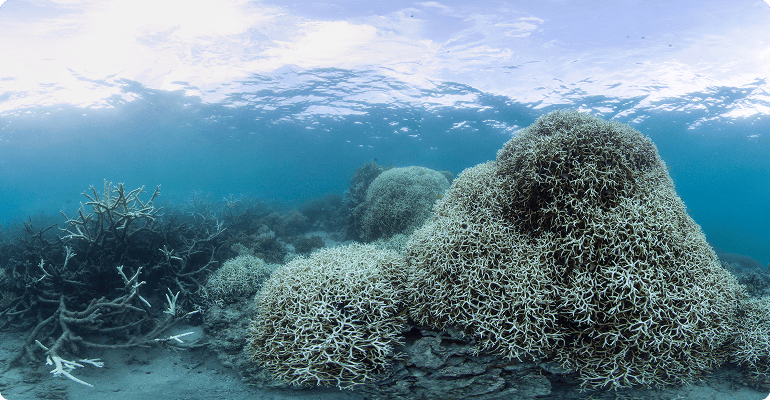
Marine heatwaves are becoming more frequent and severe. Marine heatwaves are most notable for driving large scale coral mass bleaching events, and are also responsible for large, rapid marine ecosystem shifts in other important ecosystems. - Declines and poleward migration of marine species
Ocean warming is driving a decline in marine biomass and many species are being pushed beyond their thermal tolerance limits, driving poleward migration of species toward cooler waters. Global fisheries yields are declining and could decline by up to 20 percent by 2100 on our current trajectory of warming. - Increased stratification and reduced mixing
Warmer surface waters are increasing stratification, reducing the mixing between surface and deep layers. This limits the supply of nutrients to surface waters that support marine food webs, and slows the replenishment of oxygen in deeper waters, contributing to deoxygenation.

Ocean Acidification
Ocean acidification, the second major stress to the ocean, is occurring as the ocean absorbs about a quarter of the excess CO₂ pollution from the atmosphere, resulting in an ever-more acidic ocean. When this CO₂ dissolves in seawater, it forms carbonic acid, increasing the ocean’s acidity and lowering its pH. This process has increased ocean acidity by approximately 30 percent in the Industrial Era. This change is making it more difficult for organisms, such as corals, shellfish, and certain plankton, to build and maintain calcium carbonate shells and skeletons. These organisms form the foundation of many marine food webs, so their decline can have cascading effects across ecosystems, fisheries, and food systems.
Feedback Loops that Amplify Impacts, and Push Ocean Systems Towards Tipping Points
These stressors on the ocean do not act independently. They are interconnected and often reinforce one another. For example, acidification can increase organisms’ sensitivity to heat stress and deoxygenation.
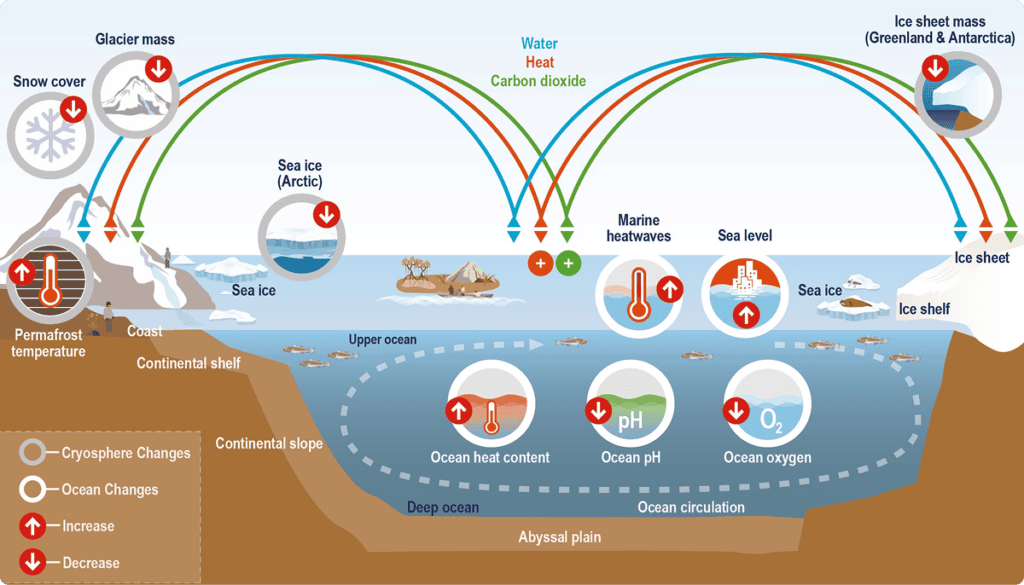
In some cases, these interactions create feedback loops that amplify impacts and push ecosystems toward tipping points—thresholds beyond which changes can become rapid and potentially irreversible. 2 examples:
- In 2025, the Global Tipping Points Report concluded that warm-water coral reefs have likely already crossed their thermal tipping point, marking the first Earth system tipping point reached under climate change. Along the current path of warming, worldwide die off of corals and their functional extinction are near certainties in the coming decades.
- Ocean warming and the large inflows of freshwater from the melting of ice on Greenland has started to slow down the Atlantic Meridional Overturning Circulation (AMOC), the largest ocean current that acts as the planet’s conveyer belt moving heat from the tropics to higher latitudes. A collapse in AMOC would plunge temperature in Europe, threatening food security in Europe and beyond.
Climate change is fundamentally reshaping ocean ecosystems through interconnected physical, chemical, and biological processes. Climate-related stressors are already driving significant ecological shifts and are expected to intensify under all emissions scenarios, with greater impacts anticipated under warmer scenarios. These impacts threaten biological diversity, reduce fisheries productivity, and undermine the ecosystem services that coastal and global communities depend on.
Taken together, climate-induced changes are the greatest stressors to marine ecosystems worldwide.
Addressing climate-driven challenges to the ocean requires both foundational steps like reducing emissions and removing carbon dioxide pollution, as well as the advancement of bold new ideas to reduce heating and acidification. Ocean Visions’ four-part strategy (link out), brings together scientific research, technological innovation, and cross-sector partnerships to support the development of new approaches for ocean and climate recovery.