
Marine Carbon Dioxide Removal Knowledge Platform
Explore the Evolving mCDR Landscape
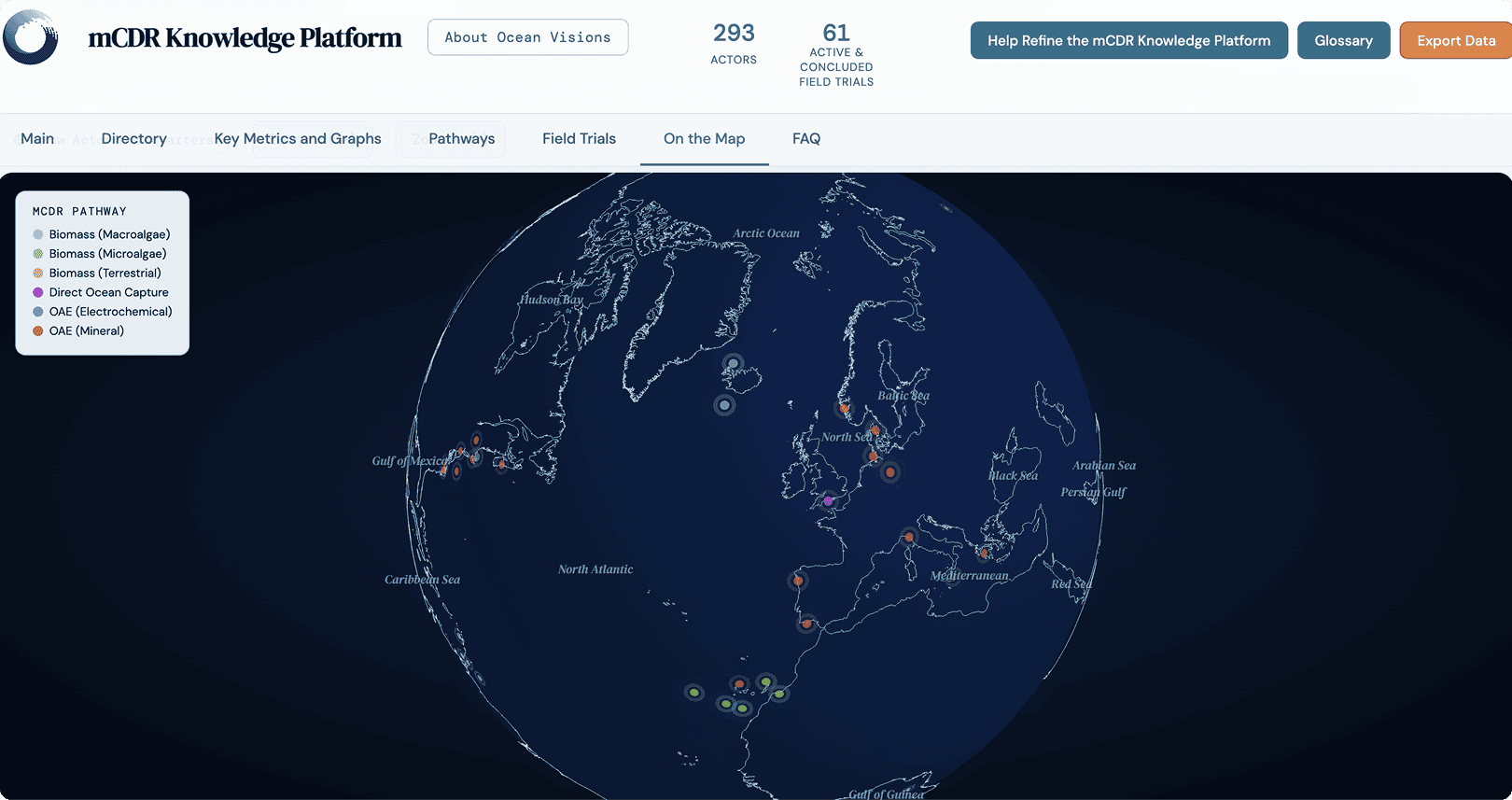
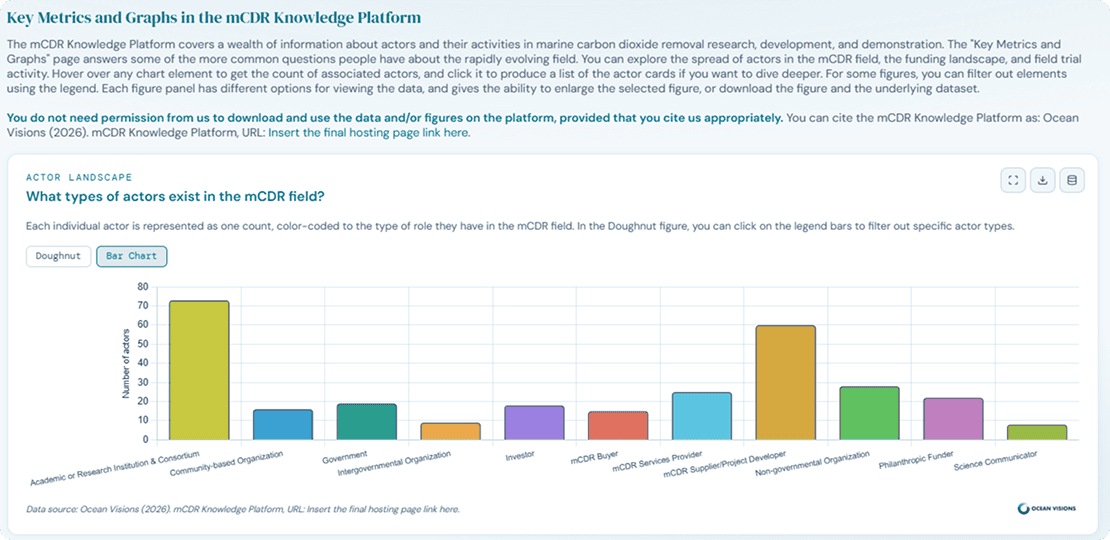
Ocean Visions’ Marine Carbon Dioxide Removal Knowledge Platform is a publicly accessible resource designed to help researchers, innovators, funders, policymakers, journalists, and other stakeholders better understand the rapidly evolving field of marine carbon dioxide removal (mCDR). Built to improve information access and transparency, the platform brings together information on organizations, technologies, projects, and field trials in one centralized, easy-to-navigate location.
Why We Built This Platform
As the mCDR field has grown, so too has the volume of information, activity, and participants working within it. Yet much of that information has remained dispersed across organizations, publications, and databases.
The Marine Carbon Dioxide Removal Knowledge Platform was created to provide a more integrated view of the mCDR landscape. By bringing together information about actors, pathways, projects, and field trials, the platform helps make the field more visible, accessible, and transparent for anyone seeking to understand its development.
What You Will Find



Built on Ocean Visions Knowledge Infrastructure
The Knowledge Platform combines and expands upon Ocean Visions’ previously released mCDR Field Trial Database and mCDR Ecosystem Database, creating a more comprehensive and integrated resource for the community.
The platform will continue to evolve with regular updates and enhancements. Users can also suggest additions or corrections through submission forms, helping maintain an accurate and up-to-date view of activities across the sector.
Part of Ocean Visions’ Work to Advance Marine Carbon Dioxide Removal
Since early 2020, Ocean Visions has played a leading role in advancing our collective understanding of mCDR and mobilizing effort and resources to the most immediate needs. As the field has grown and developed, our Remove program is now focused on getting mCDR to policy readiness by producing the needed evidence for society to decide whether (and if so, which) mCDR technologies can contribute to the overall CDR needed for climate stabilization and, ultimately, restoration. We work across science, engineering, policy and more to accomplish this work and continue to advocate for mCDR R&D in international climate and ocean arenas.
About Marine Carbon Dioxide Removal
Cleaning up carbon dioxide, or carbon dioxide removal (CDR), is now squarely on the international community’s climate action agenda, alongside the paramount work of continuing to drastically reduce global emissions. The world will need massive quantities of CDR to achieve the climate goals agreed to in the Paris Agreement.
The good news is that there are many potentially viable CDR techniques. Some of these are in the ocean—a subset which is referred to as marine carbon dioxide removal (mCDR). mCDR encompasses all CDR approaches that harness the natural power of the ocean to remove carbon dioxide from the atmosphere and store it in the deep ocean.
As climate change continues to affect ocean health through warming and acidification, understanding the potential mCDR pathways is increasingly important. While mCDR approaches show promise in becoming meaningful climate solutions, significant knowledge gaps still exist around impacts, cost, durability and scalability of different approaches. The Knowledge Platform supports that work by strengthening the knowledge base needed to inform research, collaboration, and decision-making across the field.
Start Exploring
Whether you are new to mCDR or actively working in, or interacting with, the field, the Marine Carbon Dioxide Removal Knowledge Platform provides a centralized place to discover projects, track field activity, understand relationships across the sector, and access trusted information.