Skip to content
Marine Carbon Dioxide Removal (mCDR) ​

Deep Sea Storage

Our planet is being transformed by climate disruption, with some of the worst impacts occurring in the ocean. Currently, most efforts to address climate change are focused on reducing emissions of greenhouse gases. While those efforts remain vital, they’re no longer enough. We must also clean up the “legacy” greenhouse gas pollution already in our atmosphere.

Ocean Visions believes that we may be able to harness the power of the ocean to restore the climate and the ocean itself. The ocean already holds more carbon than any other part of the biosphere and has the potential to contribute even more. The sheer scale of the ocean means that any marine carbon dioxide removal (mCDR) solutions proven to be viable and safe would have the potential to clean up billions of tons of CO₂.

A number of marine mCDR approaches are being explored—including deep sea storage.

Deep Sea Storage Overview

Marine Carbon capture and storage (CCS) is the process of capturing and storing carbon dioxide (CO₂) before it is released into the atmosphere. Usually, the CO₂ is captured from large point sources, such as coal-fired power plants, and then stored in an underground geological formation. Captured CO₂ could also be stored in the ocean water column or on the sea bed—if done so at a sufficient depth. Captured CO₂ could also be mineralized via reation with seafloor rocks, enabling permanent carbon storage. Similarly, plant waste from agricultural production or seaweed farming could be sunk to the deep ocean for long-term sequestration.
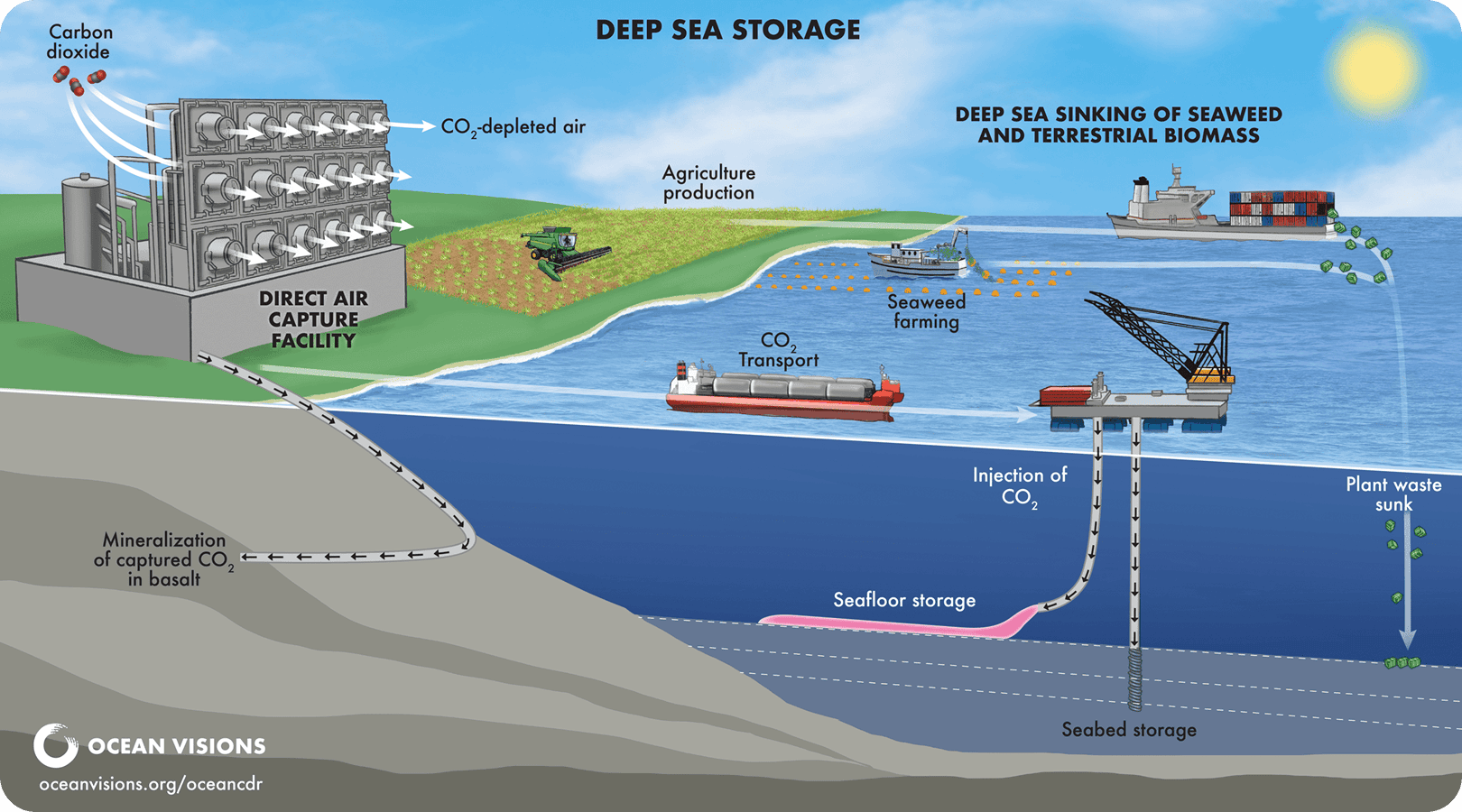
Deep Sea Storage © 2023 by Ocean Visions is licensed under CC BY-NC-ND 4.0. To view a copy of this license, visit https://creativecommons.org/licenses/by-nc-nd/4.0/
Dive Deeper

Explore mCDR Road Maps

Ocean Visions’ mCDR road maps provide overviews of potential technologies, obstacles they face, and first-order priorities needing attention to advance the field. The road maps are intended to catalyze global collaboration and engagement and will be updated and refined as advances emerge in science, technology, governance, and policy.