Marine Carbon Dioxide Removal (mCDR)
Macroalgae Cultivation and Carbon Sequestration
Our planet is being transformed by climate disruption, with some of the worst impacts occurring in the ocean. Currently, most efforts to address climate change are focused on reducing emissions of greenhouse gases. While those efforts remain vital, they’re no longer enough. We must also clean up the “legacy” greenhouse gas pollution already in our atmosphere.
Ocean Visions believes that we may be able to harness the power of the ocean to restore the climate and the ocean itself. The ocean already holds more carbon than any other part of the biosphere and has the potential to contribute even more. The sheer scale of the ocean means that any marine carbon dioxide removal (CDR) solutions proven to be viable and safe would have the potential to clean up billions of tons of CO₂.
A number of marine-based mCDR approaches are being explored—including macroalgae cultivation and carbon sequestration.
Macroalgae Cultivation and Carbon Sequestration
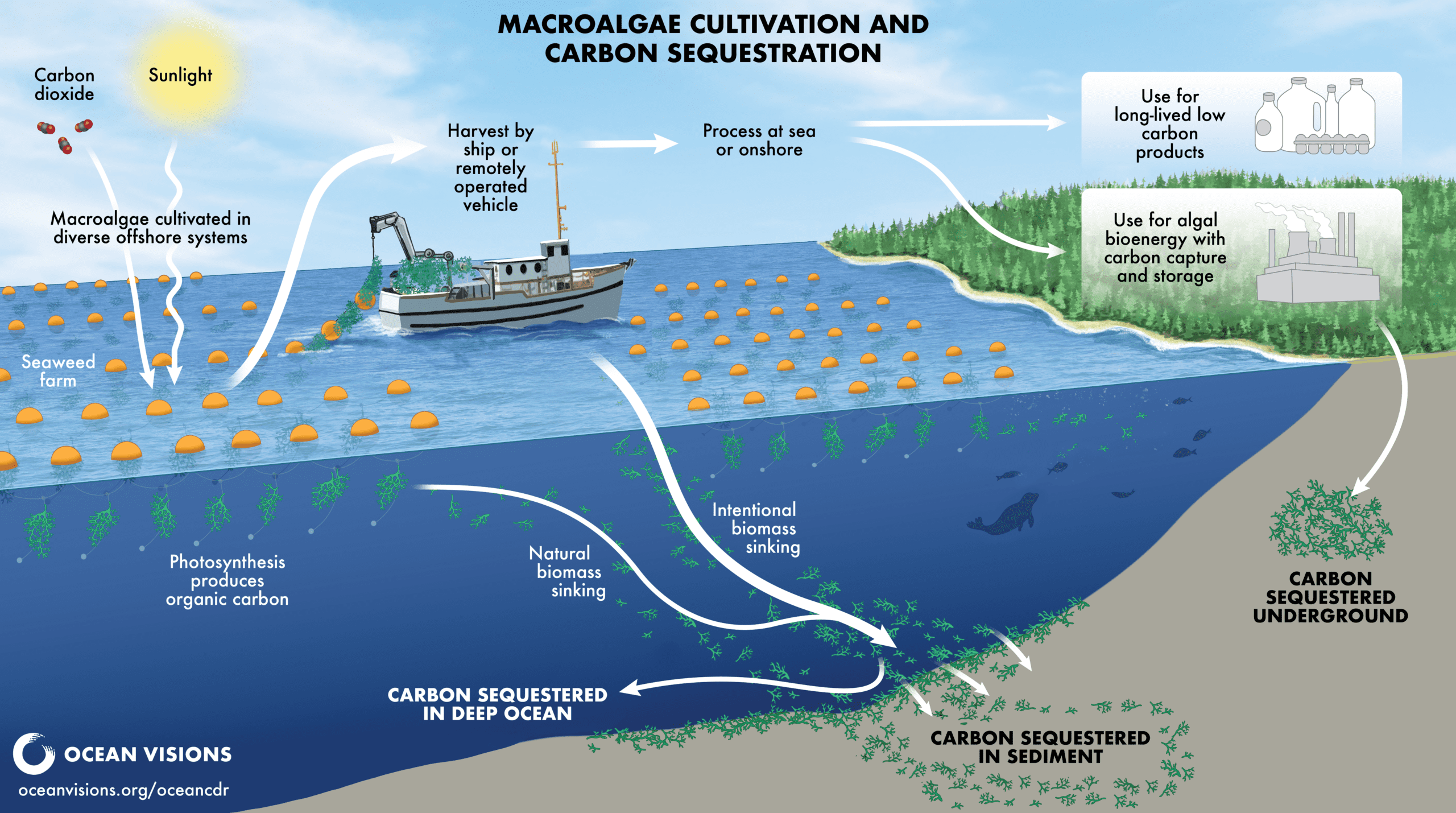
Macroalgae (also known as seaweed) converts dissolved CO₂ into organic carbon through photosynthesis. Seaweed farming or the harvesting of free-floating algae could contribute to carbon removal in three major ways. First, some of the farmed or wild macroalgal detaches from the main farm line and sinks, taking with it sequestered carbon. Second, harvested macroalgae could be used in to create biochar or other long-lived productions (e.g., bioplastics). Third, the macroalgal biomass could be harvested, compressed, and sunk to the deep ocean for permanent carbon sequestration.
Technical Potential
Macroalgae can be grown in many nearshore ocean areas, with productivity driven by nutrient availability, seawater temperature, and sunlight. It also has the potential to be grown offshore on floating structures. Taken together, the potential production is immense. Net carbon removal is constrained by the amount of the biomass that ends up sequestered on long (100+ years) timescales.
Environmental Co-Benefits and Concerns
Macroalgae cultivation has many potential climate-related co-benefits, including coastline protection via wave reduction and, amelioration of ocean acidification and hypoxia. Macroalgae can be used in polyculture systems to boost seafood production of fish and shellfish through nutrient recycling and water oxygenation. Macroalgae farms could also enhance local marine biodiversity.
Major risks of large-scale cultivation are related to loss of materials from farms with consequences for safety at sea, entanglement of marine life, and general contribution to marine debris. Biosecurity risks include the potential for genetic mixing with local species, spread of diseases and parasites, and the creation of stepping-stones for invasive marine species. Large-scale cultivation would likely result in nutrient competition with the local ecosystem, and the harvesting of wild macroalgae, such as free-floating sargassum, could have significant negative effects on co-occurring species.
Cost Considerations
Macroalgae farming has seen an impressive growth in the past decade (almost entirely in Indonesia and the Philippines), reaching 25 million tons of product in 2020. Production systems remain limited to near-shore, low capital, labor-intensive farming, often in shallow waters that are protected from wind and waves. Scaling production to hundreds of millions or tens of billions of tons of wet weight per year will require a move offshore, with more sophisticated equipment to withstand wave and wind energy, to moor lines to the ocean floor, and to harvest the biomass. Infrastructure, skilled labor, transportation, and industrial-scale drying, as well as the management of large-scale production systems will introduce new costs.
Dive Deeper
Explore mCDR Road Maps
Ocean Visions’ mCDR road maps provide overviews of potential technologies, obstacles they face, and first-order priorities needing attention to advance the field. The road maps are intended to catalyze global collaboration and engagement and will be updated and refined as advances emerge in science, technology, governance, and policy.