
Through OceániCO₂ Labs, Ocean Visions Fellow Catalina Reyes Vargas is Charting a Path for mCDR from Latin America
Caitlin Wale on Building a Case for South African Leadership in Marine Carbon Dioxide Removal
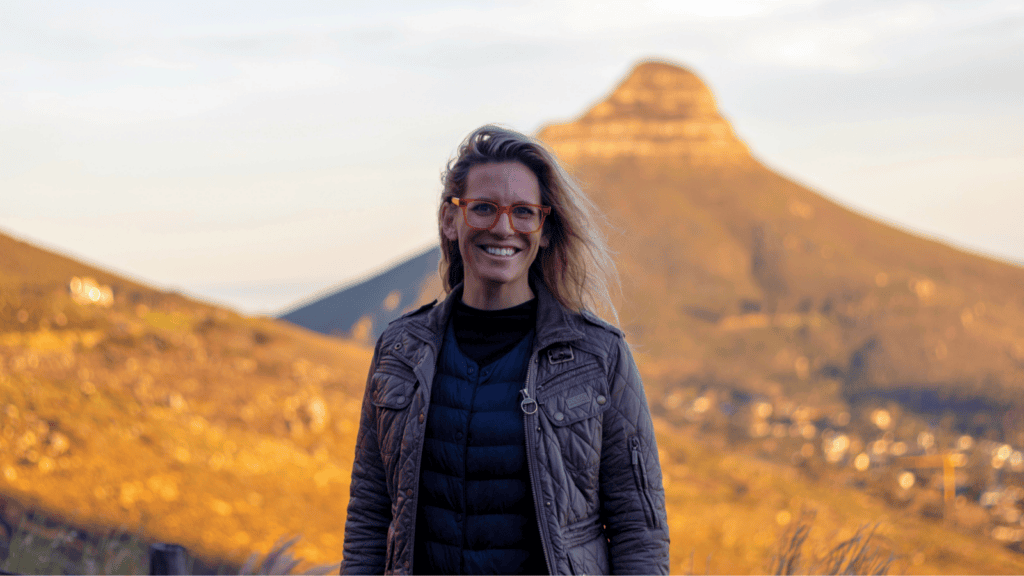
Caitlin Wale is a South African engineer and a Senior Fellow in Ocean Visions' Global Ecosystem for Ocean Solutions (GEOS) Ocean-Climate Innovation Fellowship. She is the founder of Kinjani, which helps science-first companies move from the lab to commercialization. Through Kinjani’s SAILOR initiative, the South African Innovation Lab for Ocean-Climate Resilience, she brings together scientists, industry, policymakers, and coastal communities to explore opportunities for responsible marine carbon dioxide removal (mCDR) in South Africa
How did you first connect with Ocean Visions, and how has that connection shaped your current trajectory?
I was originally an engineer in South Africa before I moved to London and into the sustainable finance field. I joined a carbon removal fund that invested globally in early-stage carbon removal companies. Our team came to one of the earliest Ocean Visions Summits, and I’ve followed the team’s work closely ever since.
I started Kinjani three years ago to support early-stage, science-first companies as they move from the lab to commercialization. I spent the early years building programs and staying connected with Ocean Visions, who invited me to join mCDR workshops related to developing an Africa mCDR Road Map. The key inflection point came about a year ago, when I saw a clearer opportunity for Kinjani to help shape mCDR innovation. South Africa has relevant mining supply chains, growing desalination needs, and a strong scientific base through entities like the Southern Ocean Carbon Climate Observatory (SOCCO), Council for Scientific and Industrial Research (CSIR), and Stellenbosch University, all of which are relevant for mCDR.
What is SAILOR, and how does it work?
SAILOR, the South African Innovation Lab for Ocean-Climate Resilience, sits at the intersection of industry, science, and policy. It connects to the ecosystem-development side of our work at Kinjani.
Our work is organized around three focus areas: mCDR pilots, water and supply chain linkages, and ecosystem restoration. In practice, that means bringing coastal communities, researchers, funders, and practitioners into shared working frameworks. It also means translating ocean-climate research into carefully governed pilot programs, including supporting the transition of industries like wastewater treatment and desalination toward more sustainable, climate-resilient operations.
How has your participation in the GEOS Ocean-Climate Innovation Fellowship program impacted SAILOR’s ocean-climate work?
Coming from outside the ocean space—and with very few ocean-focused companies in Kinjani’s pipeline—being part of GEOS has given me the confidence to lean into learning and engaging at the ocean-climate nexus. SAILOR’s UN Ocean Decade endorsement adds real credibility, especially in policy spaces. And being part of this global ecosystem means I’m not working in isolation. I can learn from how María José [Urrutia] approaches carbon removal work in Chile, see what Mariam Swaleh is leading in Kenya, and how other fellows and hubs are approaching similar challenges. Connecting these threads makes the whole process more collaborative.
Before GEOS, I had never engaged with policymakers. I was more comfortable with funders and industry players. Since then, I’ve been presenting mCDR work to policymakers across the Southern African Development Community, with a lot of coaching from Leo Valenzuela Pérez and Laura Anderson along the way. That’s taken me from nearly zero comfort to a much greater level of confidence. A recent workshop we led in South Africa brought together people from universities, government, and other governance bodies, and I was amazed by the convening power this network enables.
What ocean-climate challenges are especially important in your region, and how is SAILOR responding?
We are currently focused on closing regional data gaps related to mCDR. We recently brought together a core group of scientists to explore how we contextualize local insights, because the global conversation around mCDR is happening primarily in the northern hemisphere. In South Africa we’re lucky to have an impressive body of scientists, through CSIR´s SOCCO, and now SArOCCO, which Professor Pedro Monteiro is leading at the School of Climate Studies of Stellenbosch University. He and partners are mapping ocean carbon capabilities along the South African coastline.
We can build the infrastructure, and the modeling and monitoring, reporting, and verification (MRV) capability for mCDR exists, but data gaps still limit our ability to assess and respond to local conditions. This is a big reason local capacity is a core focus for us.
There’s also real opportunity in industrial co-location, because supply chains often intersect in a place like Saldanha Bay, which is where we’re looking at potential mCDR pilots. There are mining supply chains, transport links, alkaline materials, and new desalination facilities all going up within a similar region, so the potential lies as much in those industrial links as in the ocean itself.

A lot of the mCDR conversation in Africa reflects a perceived lack of capacity, which I'd argue is more perception than reality. The question really is how we use the capabilities we have in existing or evolving frameworks and develop our capacity so we can meaningfully contribute to the global conversation.
How do you communicate this work to diverse audiences?
I like to always start with why. Why the ocean? Why carbon dioxide removal? I also discuss the extent to which the ocean has already been sequestering carbon, and how that is affecting the ocean as emissions rise. We frame mCDR in the context of the ocean’s existing role in the carbon cycle, rather than a new, abstract technology.
In a scientific setting, it helps to frame our position as one of technical capacity. mCDR conversations are happening globally, and we don’t want decisions imposed on us. We need to build baseline data to answer safety questions and to set conditions that make sense locally. I also talk about the timeframe: roughly three years of testing, moving from lab work to mesocosm studies and then, if appropriate, piloting.
When talking to industry partners, like wastewater treatment works, many of which are managed by government municipalities here, we focus on how this work could align with funding opportunities and infrastructure upgrades. We’re in the process of putting together a Green Climate Fund proposal, which could help upgrade infrastructure and, if proven successful, help position a municipality as a local leader on ambitious climate solutions.
Community engagement requires a different approach. mCDR discussions are especially sensitive in a place like Saldanha Bay, where fifth-generation small-scale fishers already confront challenges such as low fish stocks and restrictions associated with marine protected areas. That bay also borders a listed wetland. We’re focused on co-designing with coastal communities from the outset so they can become long-term stewards of what gets implemented, and timing that engagement carefully so we’re not overpromising too soon.
Context is especially important. South Africa’s unemployment rate sits around 33%, and youth unemployment in the West Coast region where we’re targeting our pilot testing is over 40%. That makes job creation a real lever for us. But the opportunity goes beyond direct jobs. If the West Coast becomes a permitted test-bed for marine carbon dioxide removal, innovators in the region will be able to develop and test their own solutions there. Through Kinjani’s entrepreneurial training programs, our intention for SAILOR is that local communities on the West Coast are well positioned to capture that opportunity when it comes. That’s why designing with these communities, as ongoing stewards, not just stakeholders, is so central to the approach.
Five years from now, what would success look like for SAILOR, and how could that contribute to the wider ocean-climate field?
If Saldanha Bay proves to be a safe and appropriate place for testing, it would be meaningful to have it be an ocean alkalinity enhancement (OAE) pilot site, with responsible governance, social engagement with coastal communities in the area, and robust MRV capacity, demonstrating how OAE could intersect responsibly with water, mining, wastewater, and desalination supply chains. I want SAILOR to become a durable platform for responsible mCDR development — an ecosystem where scientists can de-risk ideas, and entrepreneurs can move from pilots toward replication. By bringing different fields together, I hope we can develop ocean-climate solutions more effectively, and make the process more collaborative along the way.
I’d love to see the Chile–South Africa Alliance with CINCO grow into something meaningful given how many parallels there are between our industrial supply chains, and for the Africa mCDR Partnership to mature into a collaborative effort setting standards for mCDR research and development from an African perspective. One priority close to my heart is developing a blended finance model that brings together debt, equity, grants, and returnable grants that could become a blueprint for others rather than something we all have to reinvent each time.
From a global perspective, we want South Africa to be seen as a model for what success looks like in how the mCDR industry is taking shape. We have that potential, because we have a strong scientific backbone locally, three oceans that join at the top of the continent, access to the Southern Ocean, mining supply chains, and a lot of water infrastructure still to be developed. We have all the right elements to be leading in this space. From a global perspective, we want South Africa to be seen as a model for what success looks like in how the mCDR industry is taking shape. We have that potential, because we have a strong scientific backbone locally, three oceans that join at the top of the continent, access to the Southern Ocean, mining supply chains, and a lot of water infrastructure still to be developed. We have all the right elements to be leading in this space.
Featured Blogs
July 7, 2026
What Are Mixed-Phase Clouds, and Could They Help Save Arctic Sea Ice?May 5, 2026
Accelerating Ocean Solutions for Chile’s Blue EconomyApril 28, 2026
The Ocean Can Play a Major Role in the Transition Away from Fossil FuelsJuly 15, 2025
Advocating for Ocean-Based Climate Solutions on the Global Stage